
How to read the five fields on the back of a ginseng box
Food type, ingredient name, net content, nutrition information, and manufacturer and seller. This article walks through the order of the five fields for reading the back of a KOGIN box.
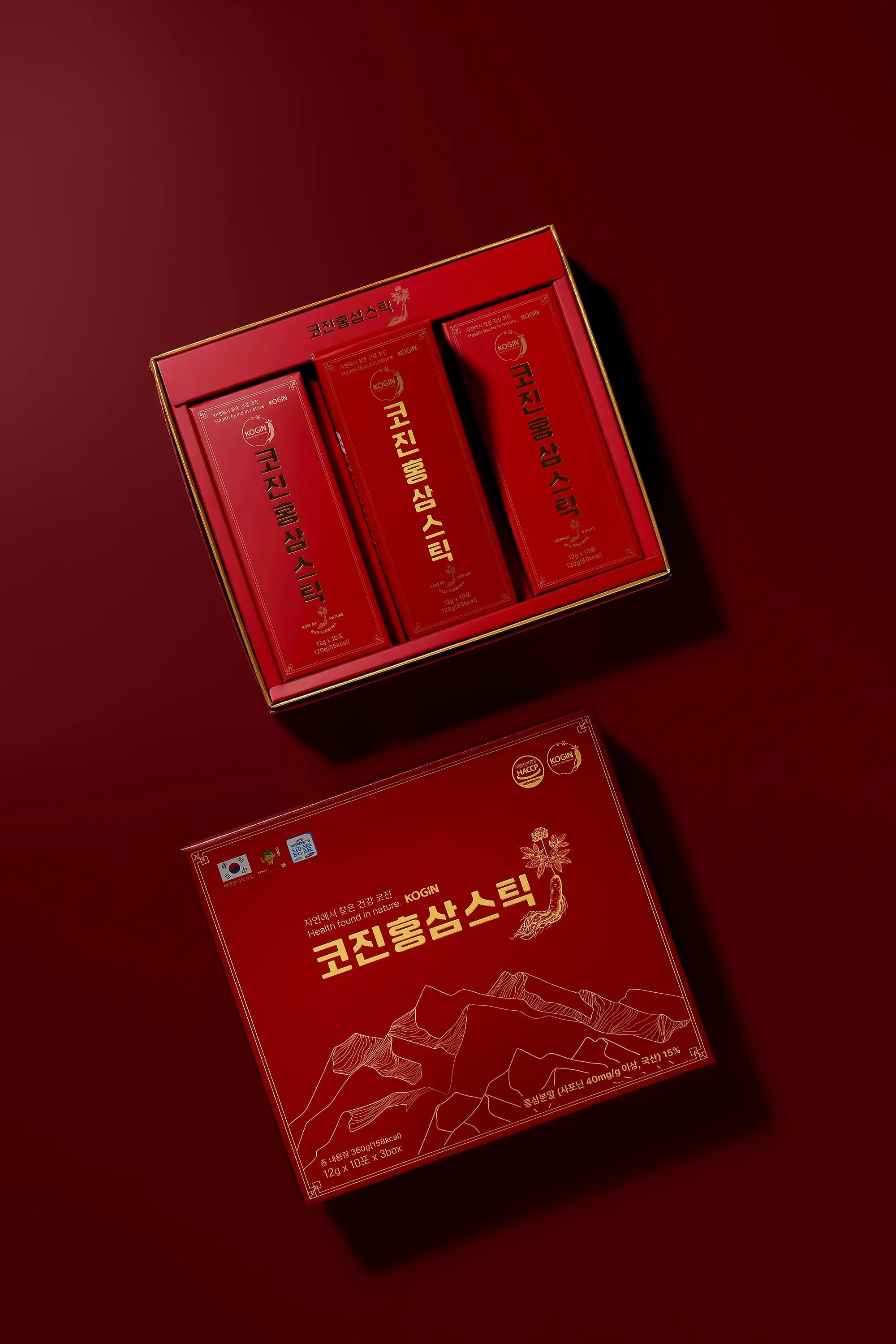
Product facts
- Food type
- liquid tea
- Net content
- 12 g x 10 sticks, total 120 g
- One Red stick
- 5 kcal, carbohydrate 1 g
- One Black stick
- 10 kcal, carbohydrate 2 g
At a glance
At a glance
Read the back of the box in this order of five fields: food type, ingredient name, net content, nutrition information, and manufacturer and seller. The five fields on the back come before the impression made by the front.
Field one: food type
The food type of KOGIN Red Ginseng Stick and KOGIN Black Ginseng Stick is liquid tea. The words red ginseng or black ginseng in the product name do not change that classification.
The food type is the field you find before the others on the package. Once this one is settled, the remaining fields can be read on the same basis.
Field two: ingredient name
Red is red ginseng powder (saponin 40 mg/g or more, Korean origin) 15% and purified water. Black adds fructooligosaccharide, xanthan gum, and purified water to black ginseng powder (saponin 40 mg/g or more, Korean origin) 12%.
The 'Korean origin' inside the parentheses is the origin marking of the powder raw material. It is a different piece of information from where the company address is, so please do not narrow down the growing region on the basis of the address.
Field three: net content
Both products are 12 g per stick, 10 sticks per box, 120 g in total. If you check the weight of one stick and the number of sticks inside the box together, it reduces the risk of comparing products with different compositions as if they were the same.
Field four: nutrition information
Read the nutrition information on the basis of one stick. Red is 5 kcal and 1 g of carbohydrate per stick. Black is 10 kcal, 2 g of carbohydrate, and 1 g of sugars per stick.
It is safer not to add the figures on the front of the box to the per-stick figures on your own. There are items where the labeling does not match, and we are checking them, so we do not describe them until they are confirmed.
| Per stick (12 g) | KOGIN Red | KOGIN Black |
|---|---|---|
| Calories | 5 kcal | 10 kcal |
| Carbohydrate | 1 g | 2 g |
| Sugars | no line printed | 1 g |
Field five: where it is made and where it is sold
The manufacturer and the seller are listed separately on the box. Hongbaek Agricultural Company Corporation (농업회사법인 주식회사 홍백) is shown as the seller of these two products.
Since the roles are separate, it is more accurate not to read the place that sells it as the place that made the finished product. Look at the two fields separately.
If you have copied them all down
- Compare only figures that share the same unit and the same basis.
- Do not rank products by a single percentage.
- Do not fill in a basis or a grade that is not on the box.
- If the package labeling changes, copy the box in your hand again instead of relying on an old note.
Why we ask you to read in this order
The five fields on the back of the box are not placed at random. They run from a broad range to a narrow one. You settle what kind of product this is, then what it is made of, how much it holds, what values are attached to one stick, and last who makes it and who sells it.
If you start in the middle, you see numbers without the context established by the preceding fields. That is why we ask you to start with the opening field on the back rather than the impression made by the front.
What is written in the parentheses describes the item in front of it
The place where people most often go wrong in the ingredient name field is the parentheses. What is written in the parentheses after red ginseng powder describes that powder, not the finished product.
The value 40 mg/g saponin or more and the origin marking 'Korean origin' are both explanations attached to the powder raw material. If you look at where the parentheses open and where they close, you can tell what the words inside them belong to.
It is more accurate not to read the value inside the parentheses as a figure for one finished stick.
Make a table for copying the five fields down
If you are comparing several products, it helps to copy the five fields of each box into the same format. Moving between them by eye alone makes it easy to mix up which box a figure came from.
| Field to copy | What to write | Point to watch |
|---|---|---|
| Food type | The words as written in the box | Do not guess it from the product name |
| Ingredient name | Everything from the beginning to the end | Include the explanation in the parentheses |
| Net content | The weight of one stick and the number of sticks | Do not write the total alone |
| Nutrition information | The unit of reference in the table heading | Check whether it is one stick or a box |
A single stick does not carry all five of these fields
Even if you have practiced reading the five fields, in the end, if all you have in your hand is a single stick, the full label is not available. A single stick carries nowhere near as much labeling as the box.
So when you need to check something, you have to find the box. If you have thrown the box away, there is no way to recover most of the five fields. Since it takes up little space, we suggest keeping even the part that carries the labeling surface.
The labeling can change as well
The values we give in this article are also copied from the labeling we can confirm at present. When you need to check something, always look at the box in your hand.
- Package labeling can change when a product is revised.
- A note you copied earlier may differ from the box you have now.
- A label photo seen online is not guaranteed to be current.
- The most accurate basis is the box you are holding now.
What to look at after the five fields
The five fields are the frame of the labeling, but the box prints other guidance as well. The intake amount, the storage method, and the cautions are among them.
For both KOGIN Red and Black, store at room temperature in a cool place away from direct sunlight. Drink it as soon as you open it, do not put the pack in the microwave as it is, and take care that the edge of the stick does not cut your hand. Once you have read all five fields, we suggest running your eye over this part as well.
There are questions that do not get an answer even after checking
There are questions that do not get an answer even when you have read all five fields without missing anything. How long to take it for, when to take it, and whether it suits you are among them.
These are not items to be marked on the box, so they do not appear however carefully you read. When the answer is not in what you have read, asking a medical professional is quicker than looking at the box more closely.
You do not have to read all of it at once
You do not have to read the five fields from the beginning to the end every time. Which fields you need depends on what you are wondering about now.
To check for ginseng if you are sensitive to it, look at the ingredient name field. To count the remaining sticks, use the net content field; to check who made the product, use the final field. Review the whole label when you open the box, then refer to the fields you need.
Even so, on a box you have just opened, we suggest reading the ingredient name field all the way to the end. For people who are sensitive to ginseng or need to avoid a particular ingredient, this single field can matter more than the other four fields together. Red has two items and Black has four, so it does not take long.
What this article does not answer
This article guides the order for reading the five fields on the back of the box. It does not deal with judgments outside the labeling.
- Reading the labels of other companies' products: we do not do that.
- Blending ratios that are not printed: they are not on the box.
- An intake plan for an individual: that needs to be checked with a qualified professional.
The ginseng blending ratio next to the ingredient name is read separately
For Red, the ingredient name lists red ginseng powder 15% and purified water, and the ginseng blending ratio lists 100% red ginseng root body. For Black, the ingredient name lists black ginseng powder 12%, fructooligosaccharide, xanthan gum, and purified water, and the ginseng blending ratio is 100% black ginseng root body.
When copying the ingredient labeling, do not replace the ingredient list with the blending ratio alone. Writing just '100% black ginseng root body' leaves out Black's three other ingredients. Copy the entire ingredient list, including the parentheses, and record the ginseng blending ratio separately with its field name.
Separate the inner box from the sales set when you write down the net content
The 12 g x 10 sticks, total 120 g in the net content field is the marking for one inner box inside the outer box. The sales item is one large outer box holding three of those inner boxes, 30 sticks and 360 g in total. When you copy the net content down, write down which box you read it from as well.
Check the product manufacturing report number for each product
The product manufacturing report number on the box is 20080467100196 for Red and 20080467100197 for Black. When you record the two products side by side, put each number under its product name. Even when the weight of a stick and the number of sticks per inner box are the same, the number in this box is different for each product.
Label checklist
What to check on the box
- Start with the food type field.
- Read the entire ingredient list.
- Check both the weight per stick and the number of sticks.
- Read the nutrition information per stick.
- Check the manufacturer and seller fields separately.
FAQ
Frequently asked questions
Are '40 mg/g saponin or more' and '15% powder' the same number?
They are different. The number in front describes the powder raw material, and the number behind it is the share that powder takes up inside the finished product.
If the company address is in Geumsan, did the raw material grow there as well?
We cannot go that far. The limit of what can be confirmed on the box is the 'Korean origin' marking on the powder raw material.
Why do Red and Black have different calories?
Because the ingredient composition differs. The nutrition information for each of the two products is labeled separately on the basis of one stick.
Do you really have to read the five fields in order?
If you keep the order, you read each later field with the standard set by the field before it. They are arranged so that the range narrows as you go.
Is the '40 mg/g saponin or more' inside the parentheses the amount in one stick?
No. It is a value that describes the powder in front of the parentheses. Please do not read it as a figure for one finished stick.
If you have a single stick, where do you see the five fields?
A single stick carries nowhere near as much labeling as the box, so most of it cannot be checked. Please find the original box.
Can I keep using label details I wrote down before?
Package labeling can change when the product is revised. Please check again against the box in your hand now.
Is there anything to look at besides the five fields?
The intake amount, the storage method, and the cautions are printed there as well: storage away from direct sunlight at room temperature, drinking it as soon as it is opened, and no heating of the pack.
What if I still have questions after reading the label?
Questions about the period, the timing, or whether it suits you are not items to be marked on the box. In that case, please ask a medical professional.
Why are the total calories for the Black box missing from this article?
There are parts of the labeling that do not match each other, and we are checking them. Until that is confirmed, we give the figures per stick.
Sources
Sources used for this article
- Korean Law Information Center: Act on Labeling and Advertising of Food, Article 4
What this source covers: label items such as product name, net content, ingredient name, place of business, and cautions