
Red ginseng and black ginseng, and how to read the difference
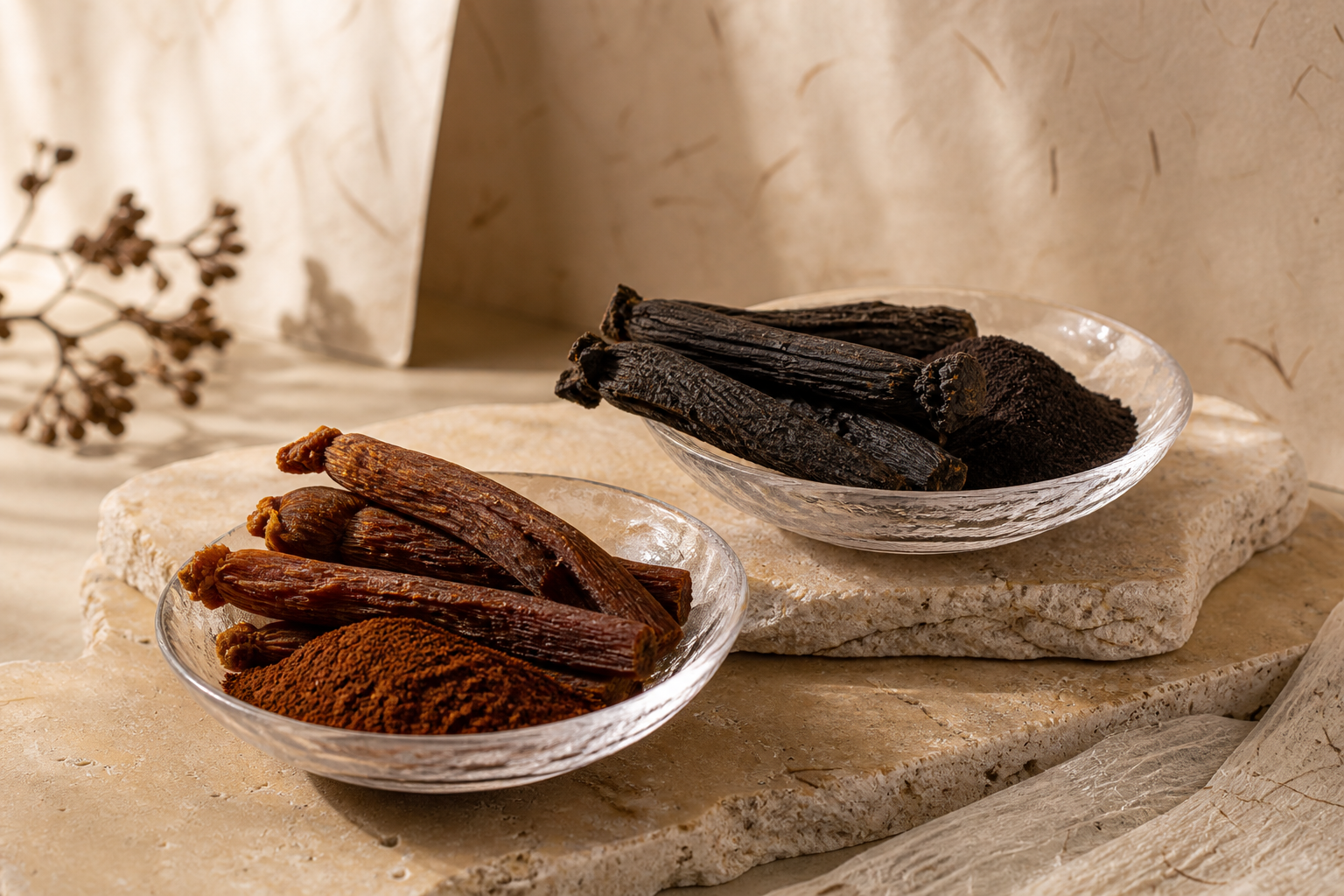
Red ginseng is made by steaming and drying fresh ginseng. Black ginseng undergoes this process three or more times. A darker color alone does not determine quality.
Product facts
- Red ingredients
- red ginseng powder (Korean origin) 15%, red ginseng root body 100%
- Black ingredients
- black ginseng powder (Korean origin) 12%, black ginseng root body 100%
- Red product manufacturing report number
- 20080467100196
- Black product manufacturing report number
- 20080467100197
- Pack size
- 12 g per stick, 10 sticks per box
- Red, one stick
- 5 kcal and 1 g of carbohydrate per 12 g stick
- Black, one stick
- 10 kcal, 2 g of carbohydrate, and 1 g of sugars per 12 g stick
At a glance
At a glance
Both start as fresh ginseng, and the number of times they are steamed and dried differs. In the KOGIN products, the raw materials and the blending ratio differ as well.
Red ginseng is made by steaming and drying fresh ginseng
Red ginseng is made by steaming fresh ginseng and then drying it. Processing gives it a color in the reddish-brown range, and it is used as an ingredient in products such as powder and concentrate.
When you look at a finished product, it helps to check the name red ginseng together with the form of the ingredient, the blending ratio, the net weight of one stick, and how to take it, so that you can understand the composition of the product in more detail.
Black ginseng undergoes more cycles of steaming and drying
South Korea's Rural Development Administration (RDA) materials introduce black ginseng as a dark brown ginseng made by going through the steaming and drying process three or more times. Repeated processing and the deeper color are what set it apart from red ginseng.
A larger number of processing steps or a deeper color does not mean that every black ginseng product is better than a red ginseng product. To understand the difference between products properly, you need to look at the raw materials, the blend, the food type, and the manufacturing information together.
The ingredients of KOGIN Red and Black differ in this way
KOGIN Red contains 15% Korean-origin red ginseng powder, specified at saponin 40 mg/g or more, with purified water as the remaining ingredient. Red ginseng powder and purified water make up its complete ingredient list.
Black contains 12% Korean-origin black ginseng powder, specified at saponin 40 mg/g or more, along with fructooligosaccharide, xanthan gum, and purified water. For both products, 40 mg/g or more is a lower limit for the powder ingredient, not a value for a finished stick.
The ginseng blending ratio is clear as well: 100% red ginseng root body for Red, and 100% black ginseng root body for Black. 'Root body 100%' means that each product uses the roots of red or black ginseng alone, without mixing in other parts such as leaves or stems. The food type is liquid tea for both.
Both products come in 12 g per stick and 10 sticks per box. Within the same package specification, the difference is clear: Red has two ingredients and Black has four. Hongbaek Agricultural Company Corporation (농업회사법인 (주)홍백) sells both under its own name, and the full labeling, including the manufacturer and the seller, is set out on the product label information page.
The numbers on one stick differ between the two products
Read the nutrition information per stick rather than as the total on the front of the box. KOGIN Red is labeled at 5 kcal and 1 g of carbohydrate per 12 g stick. KOGIN Black is labeled at 10 kcal, 2 g of carbohydrate, and 1 g of sugars per 12 g stick.
The sweetness in Black comes from fructooligosaccharide, and no sugar or high-fructose corn syrup is added. Red has nothing but purified water among its other ingredients, so it carries no separate sugars line. Even with the same food type, the numbers on a single stick differ like this when the other ingredients differ.
The product manufacturing report number is also different for each product: 20080467100196 for Red and 20080467100197 for Black. When you compare the two products side by side, it is more accurate to use this number and the ingredient name box rather than the name and the color.
How to take it and how to store it are the same
Both products come in an easy-cut individual stick pack that holds 12 g. The box sets no particular time of day, such as morning or evening or before or after a meal.
Store at room temperature in a cool place away from direct sunlight. There is no refrigeration or freezing marking on the box. The cautions are the same for both products. Individual sensitivities may cause an unwanted reaction. Take care when consuming the product, and stop if you notice any unwanted symptoms.
The manufacturer and the seller are listed separately on the box, and Hongbaek Agricultural Company Corporation (농업회사법인 주식회사 홍백) is shown as the seller. The consumer inquiries number is 041-753-0500.
We do not write anything that the labeling does not confirm
For both products, the total calories on the front of the box and the figure obtained by calculating the per-stick calories for 10 sticks do not match each other. Until it is settled which figure is correct, it is hard to compare Red and Black by total calories, so this article does not carry the total calories either.
No box carries a marking that says a larger number of processing steps or a deeper color makes a better product. The grounds on which you can compare the two products today are the food type, the ingredient name, the blending ratio, the package quantity, the nutrition information for one stick, and the manufacturer and the seller.
Red ginseng and black ginseng at a glance
| Category | Red ginseng | Black ginseng |
|---|---|---|
| Starting point | Processed ginseng made by steaming and drying fresh ginseng | Processed ginseng made by steaming and drying fresh ginseng several times over |
| Color and impression | Reddish-brown tones, from pale yellowish-brown through pale reddish-brown to deep brown | Deeper tones, such as dark brown or blackish brown |
| Processing point | Processed ginseng that has been steamed and dried | Processed ginseng that undergoes 3 or more cycles of steaming and drying |
| KOGIN ingredient labeling | Red ginseng powder (Korean origin) 15%, red ginseng root body 100% | Black ginseng powder (Korean origin) 12%, black ginseng root body 100% |
Sources
Sources used for this article
- Nongmin Shinmun (a South Korean agricultural newspaper), Types and Characteristics of Fresh Ginseng, White Ginseng, Red Ginseng, Black Ginseng, and Wild Ginseng
What this source covers: The types of ginseng and how they differ
- Rural Development Administration Green Magazine, Introduction to Black Ginseng Manufacturing and Research on Special Crops
What this source covers: How black ginseng is made