
What liquid tea is, and the four steps for reading the food type field on the box
Liquid tea is a classification in the food type field, not a product name. This guide explains which fields to read next and in what order, in four steps.
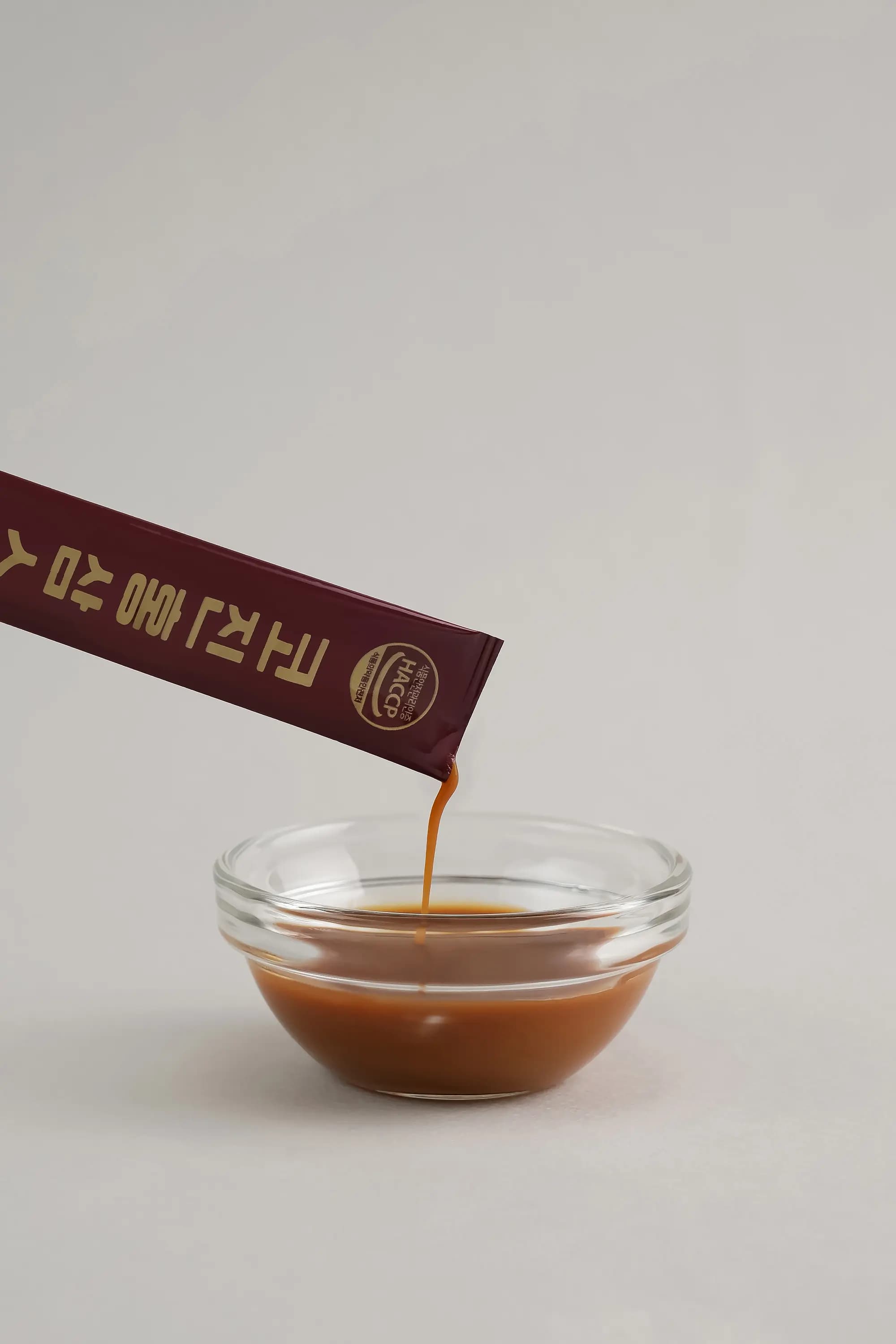
Product facts
- Food type
- liquid tea
- One box
- 12 g x 10 sticks, 120 g in total
- Red ingredients
- 15% red ginseng powder, purified water
- Black ingredients
- 12% black ginseng powder and three other ingredients
At a glance
At a glance
'Liquid tea' is the wording in the food type field of the KOGIN box. It is neither a product name nor an ingredient name, so this single term does not tell you what is inside or how much of it.
The product name and the food type sit in different fields
'KOGIN Red Ginseng Stick' and 'KOGIN Black Ginseng Stick' are the names customers use for the products. 'Liquid tea' is the food type written in the same way on both boxes. Starting from the fact that the name and the type sit in separate fields makes the rest easier to read.
The same applies when you look at another product with a similar name. Do not guess the kind from the product name, and look for the food type field on the back of the box yourself. That field is where reading starts.
This is a starting point, not a conclusion. Products labeled as liquid tea can still differ in ingredients, ingredient content, net content and nutrition information.
The six fields to read after the food type
The items you can check on our KOGIN box are set out in order below. Reading them in this order keeps the 'liquid tea' classification, ingredient figures such as '15% red ginseng powder', and pack sizes such as '12 g x 10 sticks' from running into each other.
| Order | Field to check | What the KOGIN box says |
|---|---|---|
| 1 | Product name | KOGIN Red Ginseng Stick / KOGIN Black Ginseng Stick |
| 2 | Food type | liquid tea |
| 3 | Net content | 12 g x 10 sticks for both products, 120 g in total |
| 4 | Ingredient name | the powder ratio and the other ingredients differ between Red and Black |
| 5 | Intake and storage | As directed on the box; store at room temperature in a cool place away from direct sunlight |
| 6 | Manufacturer and seller | the place that makes it and the place that sells it are listed separately |
Red and Black differ in the ingredient name field
Red lists two things, 15% red ginseng powder and purified water. Black lists four, 12% black ginseng powder, fructooligosaccharide, xanthan gum, and purified water. The same food type does not mean the same contents.
The ginseng blending ratio has its own field: 100% red ginseng root body for Red and 100% black ginseng root body for Black. This 100% refers to the parts of the raw ginseng used to make the powder, not the entire contents of a stick.
The percentages on the same box count different things. Please check the field and read them there.
The address and the country of origin are different pieces of information
The box lists the addresses of the place that makes the product and the place that sells it. Those addresses tell you where the company and the business are located, and nothing more about where the raw material was grown.
The country of origin of the raw material is shown by the 'Korean origin' marking in the ingredient name field. Read the address and the country of origin in their separate fields.
Read the label in four steps
- Start with the food type field on the back of the box.
- Keep the product name and the food type apart as two different items.
- Check the ingredient name, the content, the net content, and the nutrition information one by one.
- Finally, check the intake and storage instructions and the entity named on the pack.
The nutrition information is written per stick
Even for the same liquid tea, the figures per stick differ from product to product. Red is labeled 5 kcal and 1 g of carbohydrate per 12 g stick, and Black 10 kcal, 2 g of carbohydrate, and 1 g of sugars per 12 g stick.
Black is the one with a sugars figure, and that is because of its other ingredients. The sweetness in Black comes from fructooligosaccharide, and no sugar or high-fructose corn syrup is added. Red has purified water as its single other ingredient.
Do not add the total on the front of the box to the figures given per stick on your own, and check the values written on a per-stick basis.
The product manufacturing report number is separate for each product
The food type of liquid tea is the same for both products, but the product manufacturing report number is assigned to each product separately. Red is 20080467100196 and Black is 20080467100197.
When you want to identify a product exactly, looking at this number rather than the name or the pack color is more reliable. You can check it either in the detailed labeling or on the back of the box.
Intake and storage are the same for both products. Store at room temperature in a cool place away from direct sunlight.
Label checklist
What to check on the box
- Check that the food type is liquid tea.
- Read the product name and food type separately.
- Read the entire ingredient list.
- Check the inner-box label: 12 g x 10 sticks, 120 g in total.
- Check the address and country of origin separately.
FAQ
Frequently asked questions
If it says liquid tea, can I tell the ingredient ratios too?
You cannot. The ingredients and their ratios are in the ingredient name field, which you have to look at separately.
Are Red and Black both liquid tea?
Yes, the food type of both products is liquid tea. The ingredient name and the nutrition information per stick are different, though.
Are the place that makes it and the place that sells it different?
Yes. The box lists the manufacturer and the seller separately, and Hongbaek is shown as the seller.
Sources
Sources used for this article
- Korean Law Information Center: Act on Labeling and Advertising of Food, Article 4
What this source covers: label items such as product name, net content, ingredient name, place of business, and cautions