
KOGIN Black Ginseng Stick Label Facts
For black, we gathered the food type, the set contents, the ingredient name, the nutrition information, the intake amount, and the storage exactly as they are written on the box.
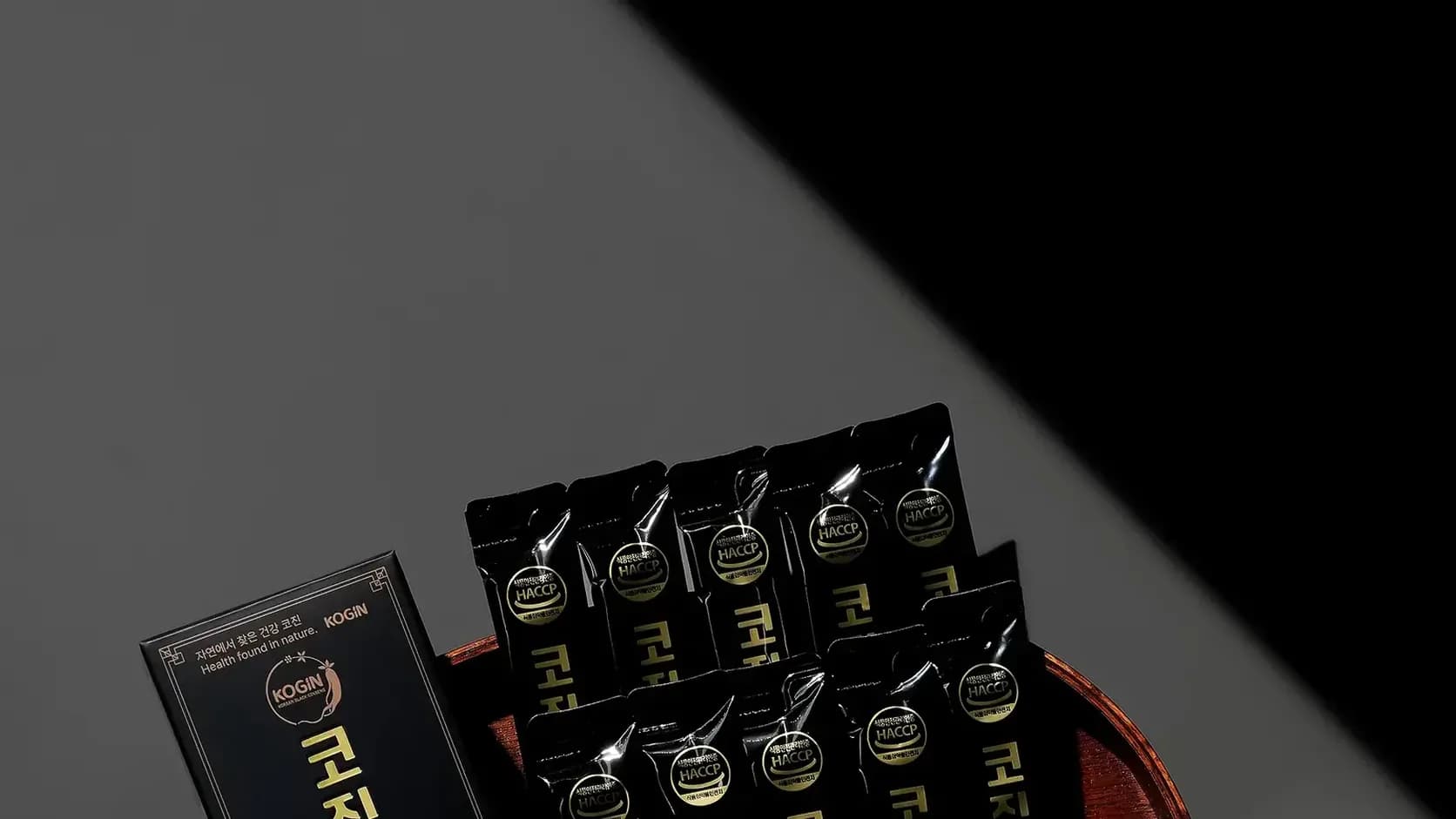
Product facts
- Food type
- liquid tea
- Net content
- 12 g x 10 sticks, total 120 g
- Main ingredient
- black ginseng powder (Korean origin) 12%
- One stick
- 10 kcal, carbohydrate 2 g
At a glance
At a glance
KOGIN Black Ginseng Stick also has the food type liquid tea, and one box holds 10 sticks. Instead of the impression of a black package, please check the labeling written on the box, such as the ingredient name, the blending ratio, and the nutrition information.
Eight items checked on the box
We have organized the scope of what we can state in a table.
| Check item | Contents printed on the box |
|---|---|
| Food type | liquid tea |
| Net content | 12 g x 10 sticks, total 120 g |
| Ingredient name | Black ginseng powder 12%, fructooligosaccharide, xanthan gum, purified water |
| Ginseng parts used | 100% black ginseng root body |
| Nutrition per stick | 10 kcal, carbohydrate 2 g, sugars 1 g |
| Intake | As directed on the box |
| Storage | Store at room temperature in a cool place away from direct sunlight |
| Labeled parties | The manufacturer and the seller are listed separately |
The scope of 100% black ginseng root body
'Ginseng parts used, 100% black ginseng root body' refers to the blending of the parts of the raw ginseng used to make the powder. It does not mean that the finished liquid tea is made of black ginseng powder alone.
The composition of the finished product is confirmed in the ingredient name field. Black ginseng powder 12% is listed together with fructooligosaccharide, xanthan gum, and purified water.
We give the nutrition information per stick only
For black, per one 12 g stick, it is 10 kcal, carbohydrate 2 g, and sugars 1 g.
The total calorie figure printed on the box together with the other figures does not fully agree with the calculation from the per-stick values, so we do not state that number until we have checked it and corrected it. We have written down only the per-stick figures that can be confirmed.
We judged that an item whose markings do not agree with each other is better left out until it has been corrected.
The intake amount and the storage
Black is taken in the same way as red, following the directions printed on the box. Store it at room temperature in a cool place away from direct sunlight.
If the package is leaking or swollen, or the sealed part has come apart, do not drink it. Do not put the package in the microwave, and please open it carefully so that you do not cut your hand on a corner.
The scope that can be checked with the box labeling
The sales set for black is one outer box containing three inner boxes of 10 sticks. It is 30 sticks and 360 g in total, and the marking of one inner box is 10 sticks and 120 g. We do not call it a higher grade on the basis of the dark packaging.
The place of manufacture and the place of sale are written separately on the box. Our company Hongbaek is labeled as the seller, and the facility pages on this site are not a description of the process that made this finished product.
We do not read the black package as a grade
A darker package color can easily make you think it is a more intense product or a higher set. There is no such marking on our box. The color is a design that tells the products apart, and it is separate from the labeling information.
That is why we do not rank Red above Black or Black above Red. Both have the same food type, liquid tea, and the same pack size: 12 g per stick and 10 sticks per box. Their ingredient lists differ.
Read the four ingredient items in order
The ingredient name field on the Black box lists black ginseng powder 12%, fructooligosaccharide, xanthan gum, and purified water. These four ingredients make up the finished product.
Just the black ginseng powder carries a percentage. The box does not state how much fructooligosaccharide and xanthan gum are in it, so we cannot confirm those amounts. We do not fill in values that are not printed with a guess.
Even when customers ask, we do not give an estimated value for an individual blending ratio that is not printed on the label.
When you compare red and black side by side
You will often want to place the two products side by side. If you already know which fields are the same and which fields differ, reading the labeling will not be confusing.
| Field | KOGIN Red | KOGIN Black |
|---|---|---|
| Main ingredient powder | Red ginseng powder 15% | Black ginseng powder 12% |
| Other ingredients | Purified water | Fructooligosaccharide, xanthan gum, purified water |
| Ginseng parts used | 100% red ginseng root body | 100% black ginseng root body |
| Set contents and intake | 12 g x 10 sticks; intake as directed on the box | 12 g x 10 sticks; intake as directed on the box |
Why we do not state the total calories on the box
On the black box there is a marking that appears to be the total calories, printed together with the nutrition information per stick, and part of it does not agree with the calculation from the per-stick figures. We have decided not to use that number until we have checked it and corrected it.
When two markings do not agree, choosing one side and presenting it would end up spreading a figure that has not been confirmed in our name. It is more accurate to give only the per-stick figures that can be confirmed: 10 kcal, carbohydrate 2 g, and sugars 1 g.
What you can do while two markings do not agree
Until we have finished the correction, customers are also better off not using that number. Most decisions can be made with the confirmed per-stick values alone.
- Start by checking the unit. The head of the table says whether a figure is per stick or per box.
- If a calculation does not add up, do not rely on that figure.
- If you need it confirmed, ask the sales channel or the consumer inquiries number.
- Do not copy a figure seen elsewhere as the value for this box.
Between the name black ginseng and the labeling
Because black ginseng is in the product name, some people read it as containing black ginseng only. If you look at the ingredient name, black ginseng powder is 12% and the other three items are listed with it.
The 100% black ginseng root body in the ginseng blending ratio field is not a statement about the finished product either. It is a marking that refers to the blending of the parts of the raw ginseng used to make the powder. If you keep in mind only that the name and the labeling point to different scopes, nothing will be out of line when you read it.
When you have a single stick in your hand
A single stick does not carry as much labeling as the box. Black and red have the same specification of one stick at 12 g, so it can be hard to tell them apart from a single stick alone.
The ingredient name, the nutrition information, the use-by date, and the manufacturer and the seller are all collected on the box. If you need to check the labeling for black, please find the original box instead of the single stick. That is why we recommend that you keep the box.
Why we leave out what cannot be confirmed
This article repeatedly says that we cannot confirm certain details. Here is why, in case that seems like avoiding the question.
A figure we state once travels from customer to customer. So if we fill in a value that is not on the box by guessing, a figure that has not been confirmed spreads in our name. Leaving it empty is more accurate, even if it is less convenient.
Once the check is finished and a correction is possible, we will write it then. Until then we will say only what is read on the box.
Customers can use the same method. When you copy a figure you have seen somewhere, note which box and which field it came from, and it will be clear later whether that figure can be used.
On the other hand, the items we can confirm are gathered in the table at the beginning of this article. The scope covers the food type, the net content, the ingredient name, the ginseng blending ratio, the nutrition information per stick, the intake, the storage method, and the labeled parties. Within these eight items we speak exactly as printed on the box.
What this article cannot answer
This article organizes the labeling printed on the black box as it is. We do not make up anything that is not on the box.
- The individual blending ratios of fructooligosaccharide and xanthan gum: they are not printed on the box.
- The total calories for the box: the markings do not agree, so we do not use the figure until it is corrected.
- Whether Red or Black is the better choice: we do not decide that for you.
The parentheses of the black ginseng powder and the product manufacturing report number
Copied with its parentheses, the item at the head of the black ingredient name is 'black ginseng powder (saponin 40 mg/g or more, Korean origin) 12%'. The 'saponin 40 mg/g or more' marking is attached to the parentheses that follow black ginseng powder, and the 12% is written outside the parentheses. These two values are not calculated as the saponin content of one finished stick.
The number for black in the product manufacturing report number field is 20080467100197. If you check the product name and then write this number as a separate item, you will not mix it up with the net content or the powder percentage.
The Black 30-stick set contains three inner boxes
When recording the outer-box contents, write 'three boxes of 10 sticks each, 30 sticks in total, 12 g x 30 sticks = 360 g'. The inner-box label, '12 g x 10 sticks, 120 g in total', is also correct. The outer box and inner box refer to different quantities.
In this set, 3 is the number of inner boxes and 30 is the number of sticks. When you check the product labeling, look at the ingredient name on the inner box, and when you count the sticks in the item for sale, look at the three boxes inside the outer box.
Label checklist
What to check on the box
- Check that the food type is liquid tea.
- Read all four ingredients in the ingredient list.
- Do not read 100% black ginseng root body as the proportion of black ginseng in the finished product.
- Read the nutrition information per stick.
- Check that the pouch is not leaking or swollen.
FAQ
Frequently asked questions
Does Hongbaek make the black ginseng stick directly?
The box lists the manufacturer and the seller separately, and our company Hongbaek is labeled as the seller.
What is the total calorie figure on the box?
The figures on the box do not agree, so we will not state a total until the correction has been confirmed. The nutrition information per stick is listed separately above.
Do Red and Black have different serving instructions?
They are the same. Both products have the same intake directions, and one stick is 12 g.
Is the dark package a more intense product?
The box makes no such claim. The color distinguishes the products; it does not indicate a grade or concentration.
How much xanthan gum is in it?
It is not stated on the box. The black ginseng powder at 12% is the item that carries a percentage, so we cannot confirm the other blending ratios.
If it is 100% black ginseng root body, why is the black ginseng powder 12%?
The two markings point to different things. The 100% is the blending of the parts of the raw ginseng used to make the powder, and the 12% is the ratio in which that powder is blended into the finished product.
What is the nutrition information per stick?
Per one 12 g stick it is 10 kcal, carbohydrate 2 g, and sugars 1 g. The total calorie figure on the box does not match the calculation, so we do not state it until we have confirmed the correction.
Can you tell from a single stick alone whether it is red or black?
Both products have the same specification of one 12 g stick, so they are hard to tell apart from a single stick. Please check the original box.
Is the storage method the same as red?
It is the same. Store it at room temperature in a cool place away from direct sunlight, and do not keep an opened stick; drink it right away.
Sources
Sources used for this article
- National Law Information Center: Article 4 of the Act on Labeling and Advertising of Foods
What this source covers: Labeling items such as product name, net content, ingredient name, place of business, and cautions